Gyotaku Fish Printing with Elementary Students: Blending Art, Nature, and Culture
Messy, a little unpredictable, and really engaging!

Quick intro
Gyotaku is a traditional Japanese printing method—paint on a fish, press paper over it, lift to reveal the print. It originally came from fishermen recording their catches, and that connection can be built into the lesson in a few different ways.
Materials
- Rubber fish
- Tempera paint
- Brushes and sponges
- Thin paper
- Wipes and table covers
Process
We started with a quick look at fish shapes and textures, then moved into printing.
Students painted a thin layer onto the fish (this took some practice), placed paper on top, and pressed gently. The reveal did most of the work—lots of reactions when the details came through.

Adding a “traditional” connection
To tie more closely to the original purpose of Gyotaku, students recorded simple measurements of their fish prints—length, width, and key features. We also used red paint to create a stamped “chop” (signature seal), similar to traditional Japanese prints.
Extension option
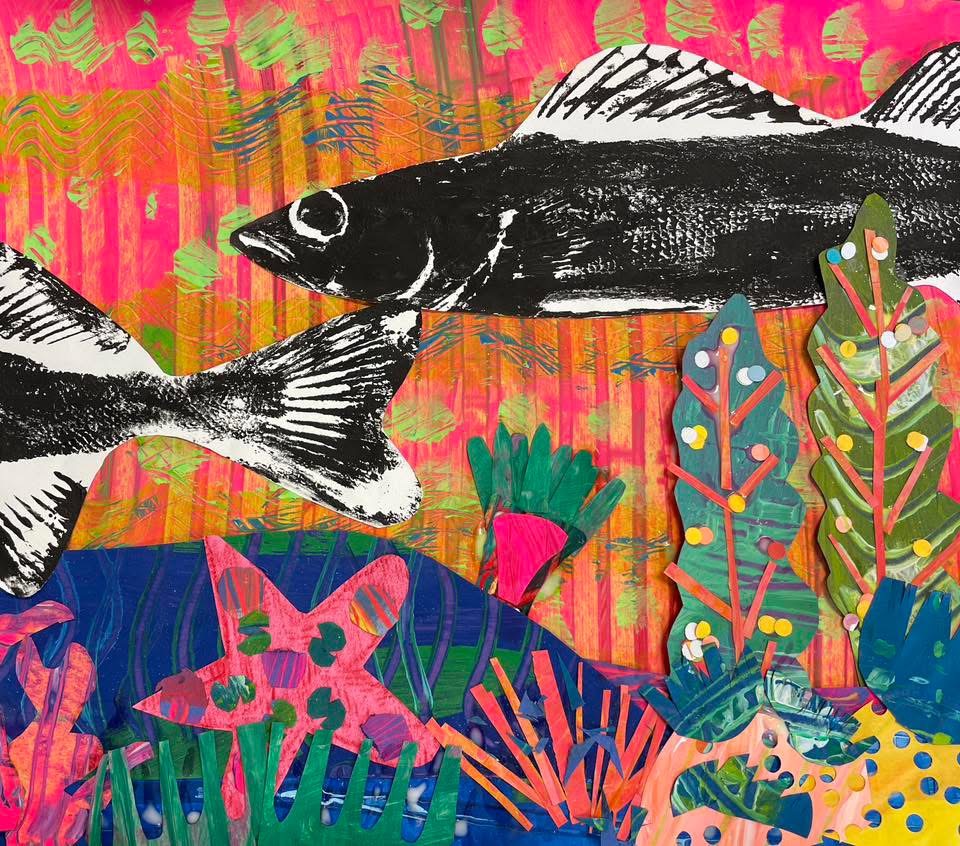
Some students took it further by creating a background first—a watercolor and collage underwater scene using colored and textured papers. After printing their fish, they cut out the Gyotaku print and pasted it into their composition. This added a nice mixed-media layer and made the fish stand out against a bold, colorful environment.


What stood out
- Getting the paint thickness right made the biggest difference
- Overprinting sometimes led to interesting textures
- Even the imperfect prints worked well once students added context or background
Small adjustments that helped
- One demo print beforehand
- Working in pairs
- Keeping instructions short once they got going
Some students added extra details—eyes, bubbles, or movement lines—while others kept the print simple.
Not a perfect process, but that’s part of it. The mix of printmaking, cultural connection, and mixed media kept students focused and gave everyone something unique to take away.
Sustainability connection
We framed Gyotaku as an early way of documenting a catch—long before cameras were available. From there, it led into a short conversation about how fishing looks different today, including the idea of overfishing and how ocean resources are managed. It stayed pretty brief, but added another layer of context without taking away from the hands-on work.
Why fishermen actually did Gyotaku
Gyotaku started in Japan in the 1800s (often linked to samurai-era fishing culture). Fishermen made prints primarily to:
- Record size and species of a catch (kind of like a photo before cameras were common)
- Document impressive or unusual fish
- Settle bragging rights or even competition results
- Sometimes sell or present the print along with the fish
STEM Connections
Gyotaku naturally blends art with STEM thinking. As learners create their prints, they engage in real scientific observation and measurement. Traditionally, fish were measured before printing—an opportunity to explore length, proportion, and scale. Students can compare measurements before and after printing, noticing how the image translates from a three-dimensional form to a two-dimensional print.
The process also encourages careful observation of fish anatomy. Look closely at the details revealed in the print—fins, scales, patterns, and textures. Where are the lines repeating? What shapes and structures can you identify? These observations connect to biology as students study the features that help fish survive in their environments.
Through gyotaku, learners build skills in:
- Measurement and scale (mathematics)
- Observation and classification (science)
- Pattern recognition and structure (engineering thinking)
- Process and experimentation (the heart of STEM inquiry)
This hands-on experience turns art-making into a scientific investigation, where every print becomes both a creative work and a record of discovery.