🎨 Big Eyes, Bright Skies: Embracing Whimsy in the Art Room
In our recent “Fantasy Landscapes” unit, students combined narrative thinking with technical skill to design imaginary environments using both observation and invention. This project was structured to support key learning goals in composition, color theory, and cultural appreciation, all while leaving plenty of room for joyful expression.

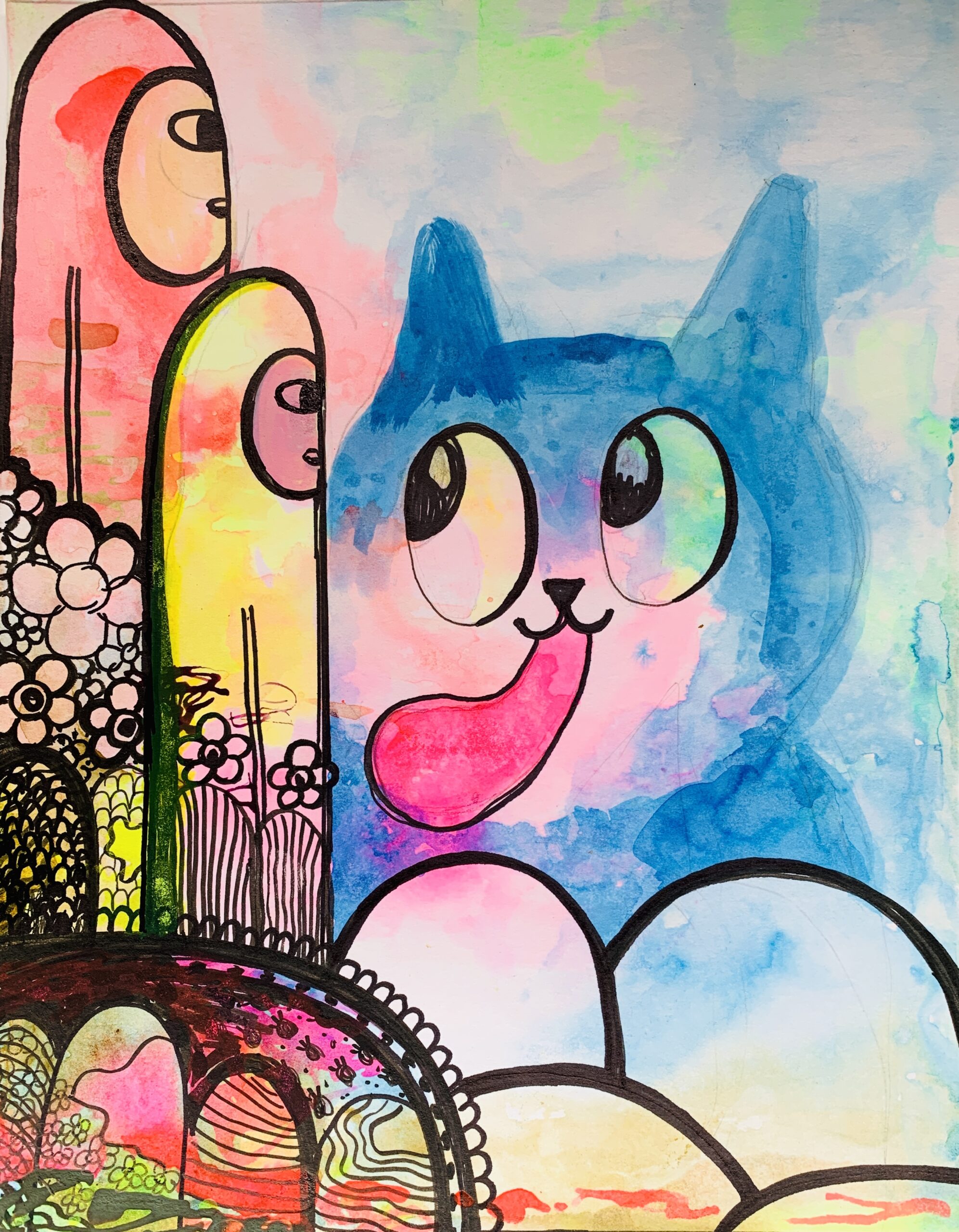
We introduced the unit by exploring examples of fantastical art across cultures, with special attention to Japanese visual culture—including anime, kawaii design, and the dreamlike settings of Studio Ghibli films. Students were fascinated by how emotion is expressed through simplified, stylized forms, and many gravitated toward the bold, oversized eyes often used to convey personality and charm.
In this featured piece, we see those ideas come to life: a central character with sparkling anime-style eyes, surrounded by a vivid dreamscape filled with playful, surreal details. From the mushroom-covered mountain to the hot dog-shaped creature peeking out from behind, the artwork is both whimsical and wonderfully composed.
🧠 What We Taught:
- Color Gradients: Blending warm and cool hues for a glowing, atmospheric background.
- Foreground/Middleground/Background: Structuring space using layering techniques.
- Cultural Influence: Identifying and respectfully incorporating stylistic elements from Japanese media.
- Character Design: Giving life to inanimate objects using expression, symmetry, and scale.
- Creative Risk-Taking: Making unusual combinations and trusting one’s own visual instincts.
💬 Student Spotlight
“I wanted the cat to feel like it was magical, like something you’d see in a dream. I made its eyes huge so it looks sweet and curious—like a character in a manga.”
— 10th Grade Student
Moments like these remind us that when we pair technique with intentional storytelling, students begin to see themselves as creators—not just of images, but of meaning.
📊 Assessment Snapshot
Here’s a simplified rubric we used to guide and assess the project:
Use of Color and Blending: Emerging, Developing, Proficient, Exemplary?
Composition & Spatial Planing: Emerging, Developing, Proficient, Exemplary?
Creativity & Originality: Emerging, Developing, Proficient, Exemplary?
Incorporation of Cultural Influence: Emerging, Developing, Proficient, Exemplary?
Effort & Craftsmanship: Emerging, Developing, Proficient, Exemplary?
🎨 Try This: Reflective Prompt
Ask your students (or children at home!):
“If you could live inside the world you created, what would a day there look like? Who would you meet, and what kind of adventures would you have?”
Encouraging imaginative writing alongside art deepens the experience and helps students connect visually and verbally with their ideas.
Whether students are channeling the soft surrealism of a Ghibli film or inventing their own whimsical worlds, this kind of open-ended artmaking helps them explore identity, culture, and storytelling through a visual lens.
🖌️ Keep making magic,
Miss Bex
Art Educator & Imagination Encourager