From Ocean Lab to Art Lab: A Bubble Painting Sea Jelly Investigation
Recently, I had the incredible opportunity to go behind the scenes at the Animal Spotlight: Sea Jellies programme at the Singapore Oceanarium. What made this visit so special wasn’t just seeing the sea jellies on display — it was learning how they are carefully bred, raised, and sustained by a dedicated team of aquarists.

During the tour, we:
- Learned about the breeding cycle of sea jellies and how delicate each stage of their life is
- Observed how they are fed
- Discovered that the Oceanarium actually grows plankton as a food source for the jellies
Students are always amazed to learn that the Oceanarium cultivates its own plankton — a reminder that ecosystems, even in aquariums, depend on interconnected systems.
Another fascinating takeaway: sea jellies aren’t technically fish. Because they don’t have fins, gills, a heart, or even a brain, it is scientifically more accurate to call them “sea jellies.” That small language shift encourages deeper scientific understanding.
All of this learning flowed straight into our art room.


There are multiple ways to bubble paint. This time, I experimented with a new way and really liked the effect! I made a dish soap and water solution and blew bubbles in it. Next, using a large spoon, I scooped the bubbles onto the paper and pressed the paint-loaded foil over the bubbles to create this colorful crinkled effect. Repeat until it looks amazing.
Another way would be to mix the paint directly into the water and dish soap solution in a large cup. Use a straw to blow bubbles and hold a piece of paper over the top of the cup to imprint the bubbles. This creates a more uniform bubble effect.
Bubble Paint Sea Jelly: The Process
To capture the soft, translucent, drifting quality of sea jellies, we explored a bubble and press-painting technique.
Materials:
- Dish soap
- Water
- Cups
- Straws
- Spoons
- Watercolor or thick paper
- Watercolor or washable paint
- Aluminum foil
Step 1: Create the Bubbles
We mixed dish soap and water in a cup. Using a straw, students gently blew into the mixture to build a mound of bubbles.
Instead of printing directly from the cup, we used a spoon to scoop the bubbles and place them onto watercolor paper. This created beautiful, airy circular forms — perfect for the bell of a sea jelly.
Step 2: Press in the Color
While the paper was still wet from the bubbles, I placed small blobs of watercolor onto a piece of aluminum foil.
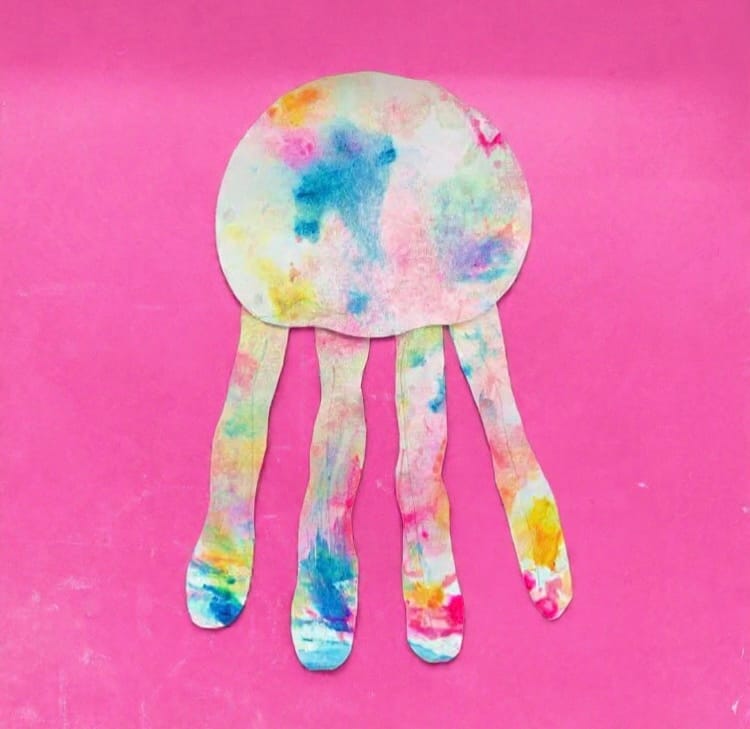
We then gently pressed the foil (paint side down) onto the wet paper. When lifted, the paint bloomed and spread in organic, unpredictable ways — creating layered, watery effects that mimic how sea jellies pulse and drift through water.
The aluminum foil adds subtle texture, and the wet surface allows the watercolor to move much like plankton drifting in ocean currents.
Step 3: Assemble the Sea Jelly
Once dry, we cut out the rounded form and added flowing tentacles. Against a bright background, the sea jelly appears to float — just like the graceful ones we observed at the Oceanarium.
Why This Lesson Matters
This project connects beautifully to:
- Marine biology – Understanding breeding cycles and food systems
- Ecosystems thinking – Seeing how plankton growth supports sea jelly survival
- Scientific vocabulary – Why “sea jelly” is more accurate than “jellyfish”
- Process art exploration – Experimenting with bubbles, pressure, and water


Art becomes more meaningful when rooted in real-world observation. Visiting the Singapore Oceanarium reminded me that creativity and science are deeply connected — both require curiosity, experimentation, and patience.
Just like the sea jellies we learned about, every artwork that emerged was completely unique.