Divergent Thinking Art Lesson: Turning Paint Blobs Into Birds
Transforming ambiguity into possibility. This is a lesson and exercise for all ages – therapeutic for adults!
This lesson builds creative thinking by strengthening students’ divergent thinking skills.
Sometimes the best way to grow creativity is to start with a (controlled) mess.
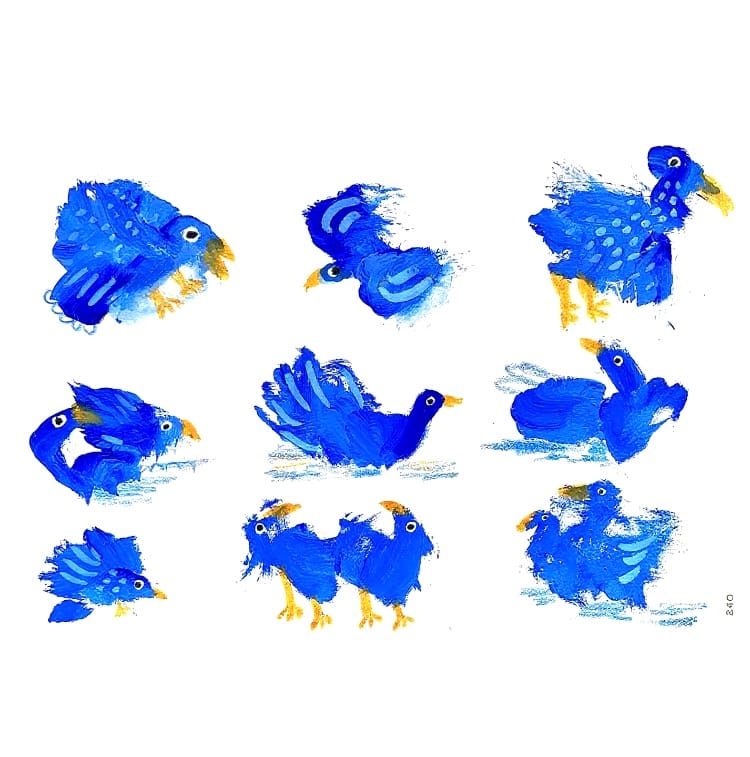
Students begin by doing something wonderfully freeing: they throw down paint and make blobs.
No sketch.
No plan.
No “right” shape.
Just color, movement, and courage.
Large blobs. Tiny blobs. Swirly, splattery, lumpy blobs. We let them exist exactly as they are — and then we let them dry.
That’s when the real thinking begins.


The Creative Constraint
Once dry, students receive a very limited set of tools:
- 2 markers
- 2 pencils
That’s it.
Their challenge?
Turn every blob into a bird.
No skipping the “awkward” ones. No repainting. No starting over.
Just observation, imagination, and problem-solving.
What Students Are Really Learning
This lesson looks playful (and it is!), but it is also deeply intentional.
Divergent Thinking
Students must ask:
- What could this shape become?
- Where might the head be hiding?
- What happens if I rotate the page?
- Could this bump become a wing?
There isn’t one correct answer. There are many possibilities.
They move from “What is it supposed to be?”
to
“What else could it be?”
That shift is the heart of creative thinking.
Flexibility & Risk-Taking
Not every blob cooperates.
Some are beautiful immediately.
Some look… questionable.
Students learn to work with what they have. Instead of erasing or starting over, they adapt. They experiment. They try again.
This builds resilience — a core creative skill.

Creative Confidence
When a student turns a random paint shape into a recognizable bird, something clicks.
They realize:
“I can figure this out.”
“I can transform something unexpected.”
“My ideas matter.”
Confidence grows not from perfection, but from problem-solving.
Comfort with Limitations
By restricting supplies, we increase imagination.
With only 2 markers and 2 pencils, students must:
- Make intentional choices
- Use line thoughtfully
- Create texture with limited tools
- Suggest detail instead of overworking
Constraints do not shrink creativity — they sharpen it.
STEAM Connections
This lesson naturally connects across disciplines:
Science
- Observing bird anatomy: beaks, wings, feathers, posture
- Discussing how different shapes relate to different bird species
- Exploring adaptation (Why are some birds round? Sleek? Angular?)
Technology & Engineering
- Iterative thinking: try, adjust, refine
- Working within constraints (a core engineering practice)
- Rotating and re-seeing forms — visual problem solving
Mathematics
- Shape recognition
- Symmetry vs. asymmetry
- Proportion and spatial reasoning
Language Arts
- Naming their bird species
- Writing a short habitat description
- Creating a fictional field guide entry
Art becomes the entry point into interdisciplinary thinking.
Reflection Questions for Students
You might invite students to reflect in writing or discussion:
- Which blob was hardest to transform? Why?
- Did you rotate your paper? What changed?
- What surprised you about your birds?
- How did the limited supplies affect your choices?
- What did you do when you felt stuck?
- How is this like solving a problem in real life?
These questions help students connect process to mindset.
Extensions & Variations
- Turn blobs into underwater creatures, insects, or imaginary animals.
- Limit students to one continuous line.
- Pair students and swap blobs to encourage collaborative problem-solving.
- Create a class “Blob Bestiary” wall display.
You can repeat this lesson throughout the year and watch creative confidence grow.
Why It Matters
Perfectionism is one of the biggest barriers to creativity.
When the starting point is unpredictable, students stop trying to “get it right” and start exploring.
They learn that creativity isn’t about waiting for inspiration.
It’s about responding to what’s in front of you.
And sometimes…
All it takes is a blob.